

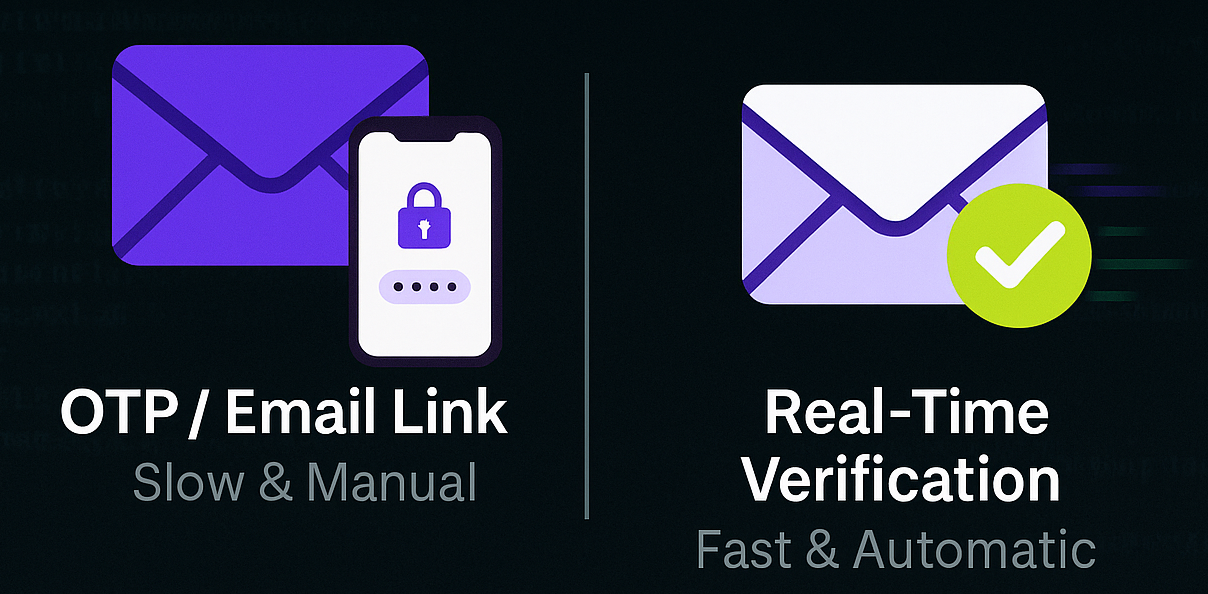
When it comes to email verification, not all methods are created equal. Many businesses rely on traditional verification methods like One-Time Passwords (OTP) or verification links, assuming they’re doing enough to validate email addresses. But here’s the truth: these methods only scratch the surface of what email verification should actually accomplish.
In this post, we’ll explore the critical differences between real-time email verification (like Kickbox) and traditional methods like OTP and verification links—and why choosing the right verification method can make or break your email marketing success.
The Fundamental Difference: Existence vs. Quality
What OTP and Verification Links Actually Check
OTP and verification link methods work on a simple principle: if a user can receive an email and click a link or enter a code, the email must be valid. While this seems logical, it only answers one question: “Can this email address receive emails right now?”
What these methods don’t check:
- Whether the email address is deliverable long-term
- If the email is from a disposable or temporary service
- Whether the domain has a poor sender reputation
- If the email is a role-based address (like info@, support@) that might not be monitored
- The overall quality and risk level of the email address
- Whether the email will end up in spam folders
What Real-Time Email Verification (Kickbox) Checks
Real-time email verification services like Kickbox go far beyond simple existence checks. They perform comprehensive quality analysis in real-time, evaluating:
- Deliverability – Will emails actually reach the inbox?
- Domain reputation – Is the email domain trustworthy?
- Disposable email detection – Is this a temporary email service?
- Role-based address detection – Is this a generic business email?
- Free email service detection – Is this from a free email provider?
- Syntax validation – Is the email format correct?
- MX record validation – Does the domain accept email?
- SMTP validation – Can the mailbox actually receive mail?
- Risk assessment – What’s the likelihood this email will cause deliverability issues?
The Spam Folder Problem: Why OTP and Verification Links Fail
Here’s a scenario that happens far too often:
A user signs up for your service and enters their email address. You send them a verification link or OTP code. The email gets delivered—but it lands in their spam folder. The user never sees it, never verifies their account, and you’ve lost a potential customer.
According to Validity’s 2023 Email Marketing Insights report, approximately 14% of legitimate marketing emails fail to reach the inbox. For transactional emails like OTP codes and verification links, this percentage can be even higher because:
- New domains or IPs sending verification emails often trigger spam filters
- Generic “verification” subject lines are red flags for spam filters
- Automated emails from new services lack sender reputation
- Users may not check spam folders regularly
With real-time email verification, you can identify problematic email addresses before you send anything. This means you can:
- Block risky addresses that are likely to end up in spam
- Flag disposable emails that users will abandon
- Prevent signups from addresses that will never receive your emails
- Protect your sender reputation from the start
The Hidden Costs of Poor Email Quality
What Happens When You Only Use OTP/Verification Links
Let’s say you accept a user’s email address, send them a verification link, and they successfully verify. Great, right? Not necessarily. Here’s what you might have missed:
- Disposable email addresses – Users sign up with temporary emails, verify, then abandon the account. You’ve wasted resources on a user who will never engage.
- Role-based addresses – Business emails like “[email protected]” might verify, but they’re often not monitored by the person who signed up. Your marketing emails go unread.
- Low-quality domains – Emails from domains with poor reputation verify fine, but when you send marketing emails later, they bounce or get marked as spam, damaging your sender reputation.
- Free email services – While not inherently bad, free email users often have lower engagement rates and higher churn.
The Real-Time Verification Advantage
Real-time email verification catches these issues at the point of entry, allowing you to:
- Block disposable emails – Prevent signups from temporary email services
- Flag risky addresses – Review or block emails from domains with poor reputation
- Identify role-based addresses – Decide whether to allow generic business emails
- Maintain list hygiene – Keep your database clean from day one
- Protect sender reputation – Avoid sending to addresses that will bounce or spam
Real-World Impact: A Side-by-Side Comparison
| Scenario | OTP/Verification Link | Real-Time Verification (Kickbox) |
|---|---|---|
| User signs up with disposable email | ✅ Verifies successfully ❌ User abandons account ❌ Wasted resources | ❌ Blocked at signup ✅ User must use real email ✅ Higher quality signups |
| Email goes to spam folder | ❌ User never sees verification ❌ Account never activated ❌ Lost customer | ✅ Email quality checked first ✅ Lower spam risk ✅ Better deliverability |
| Domain has poor reputation | ✅ Verifies successfully ❌ Marketing emails bounce later ❌ Damaged sender reputation | ✅ Flagged as risky ✅ Can block or review ✅ Protected reputation |
| Role-based email ([email protected]) | ✅ Verifies successfully ❌ Emails go unread ❌ Low engagement | ✅ Detected as role-based ✅ Can require personal email ✅ Better engagement |
| Invalid email format | ❌ May verify if typo is valid address ❌ Wrong person receives emails | ✅ Syntax validation catches errors ✅ Domain/MX validation confirms validity ✅ Prevents typos |
The Best of Both Worlds: Combining Methods
While real-time verification is superior for email quality assessment, there’s a case for using both methods together:
- Step 1: Real-time verification – Check email quality, deliverability, and risk level at signup
- Step 2: OTP or verification link – Confirm the user actually has access to the email address
This two-step approach gives you:
- Quality assurance from real-time verification
- Access confirmation from OTP/verification links
- Maximum protection against bad actors and low-quality emails
- Higher conversion rates and better user experience
However, if you must choose one method, real-time verification provides far more value because it addresses the root cause of email deliverability issues, not just the symptom.
Why This Matters for Your Business
The choice between verification methods isn’t just about technical implementation—it’s about business outcomes:
- Higher conversion rates – Real emails from engaged users convert better
- Lower bounce rates – Clean lists mean better deliverability
- Protected sender reputation – ISPs trust you more when you send to quality addresses
- Better ROI – Marketing emails reach real people who can actually buy
The Bottom Line
OTP and verification links serve a purpose: they confirm that a user can access an email address at a specific moment. But they don’t tell you anything about the quality of that email address, its deliverability, or its long-term value to your business.
Real-time email verification like Kickbox goes deeper, providing the intelligence you need to:
- Build high-quality email lists from day one
- Protect your sender reputation
- Improve email deliverability
- Reduce wasted marketing spend
- Increase conversion rates
- Avoid the spam folder problem
In an era where email deliverability can make or break your marketing campaigns, choosing the right verification method isn’t just a technical decision—it’s a business strategy.
Don’t just verify that emails exist. Verify that they’re worth your time, money, and marketing efforts.
Ready to implement real-time email verification? Check out the Kickbox Integration plugin for WooCommerce, which provides real-time verification during checkout and powerful batch verification for your existing customer lists.